Naval Intelligence in Hampton Roads: 1861-1862

Posted on
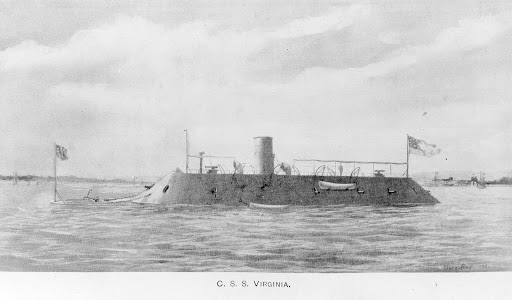
CSS Virginia.
The Mariners’ Museum.

There was no formal naval intelligence system established during the American Civil War. While a few examples exist of Northern sympathizers, free Blacks, like Mary Louvestre of Portsmouth, sent messages to various Union commanders about the Confederate ironclad construction effort. These links were unofficial and were generally between one Union officer and an individual. The Union nor the Confederacy needed to rely on such clandestine methods since Northern and Southern newspapers provided ample information, usually in a boastful manner. Each antagonist simply needed to obtain a copy ofThe New York TimesorMobile Registerto gather all they needed to know about ironclad development.

Union intelligence was able to receive valuable knowledge about theconstruction and impending attack of CSSVirginia. The information appeared to flow back and forth across Hampton Roads. On October 6, 1861, Major General John Ellis Wool, stationed at Fort Monroe as commander of the Union Department of Virginia, wrote to Lieutenant General Winfield Scott:Read more

USS Cumberland – Sink Before Surrender

Posted on
U.S. Frigate Cumberland. Lithograph. Published by Currier & Ives,
ca. 1843-1848. Courtesy of Library of Congress.

USSCumberland,flagship of the US Navy’s Home Squadron, was dispatched to Gosport Navy Yard, Portsmouth, Virginia, upon the sloop’s return from a brief cruise to Veracruz, Mexico. It was hoped that the warship’s presence would deter any effort to capture the yard during the secession crisis. Gosport was the largest and most advanced navy yard in the United States. Besides its granite dry dock and other ship repair/construction facilities, Gosport housed 14 warships, including the steam screw frigate USS Merrimackawaiting repair and others in ordinary like USSRaritan. TheCumberland, then commanded by Captain Garrett J. Pendergrast, was anchored just off Gosport so its firepower could be utilized to defend the yard or cover the release of ships.

Three days afterVirginialeft the Union on April 17, the Union abandoned the yard.Cumberland’screw helped to destroy the facility and various ships. By 4:20 a.m. on April 21,Cumberland, loaded with sailors and Marines, was towed out of the yard by USSPawneesupported by the tug USS Yankee.Cumberlandslowly passed the burningMerrimack,not realizing that what seemed to be a burning hulk would become the sloop’s death knell less than one year later.Read more

Battle of Wassaw Sound and CSS Atlanta

Posted on
Sketch of CSS Atlanta. Robert G. Skerrett, artist.
Date unknown. The Mariners’ Museum # PNc0001.

The CSSAtlantawas an ironclad transformation effort which used the iron-hull and Scottish-built engines of SSFingal to fashion one of the Confederacy’s most powerful warships. The ironclad; however, had a deep draft which limited its operational area below Savannah. This coupled with a very rash and impetuous captain, Commander William Webb, resulted inAtlanta’s capture in a brief engagement with the monitors USSWeehawkenand USSNahant. The ironclad soon became the USSAtlantaand served until 1865 in the James River. It was later sold to Haiti and floundered en route without a trace.

SSFingal

TheAtlantahad its genesis from the merchant ship SSFingal. This merchant ship was constructed at the J & G Thomson’s Clyde Bank Iron Shipyard at Govan in Glasgow, Scotland. TheFingal’s dimensions were:Read more

USS ROANOKE: THE THREE-TURRETED MONSTER

Posted on
USS Roanoke during service as a steam frigate. Lithograph, artist and date unknown. Courtesy of Naval History & Heritage Command #NH 45364

The USSRoanokewas aMerrimack海尔集团蒸汽螺钉护卫舰建造在通话软管Navy Yard. The frigate was commissioned in 1857 and became the flagship of the Home Squadron. When the Civil War erupted,Roanokecaptured several blockade runners and fought during the March 1862 Battle of Hampton Roads. Noting how the Confederates had transformedMerrimackinto the ironclad CSSVirginia,the woodenRoanokewas converted into an ironclad at the Brooklyn Navy Yard. The newRoanokefeatured three turrets; however, the extra weight of the iron made the vessel unstable and it spent the rest of the war in Hampton Roads, Virginia, and was scrapped in 1883.

A Novel Example of Naval ArchitectureRead more

Gosport Navy Yard is Recaptured

Posted on
Ruins of Norfolk Navy Yard, Virginia. Alexander Gardner, photographer, ca. 1865. Courtesy Library of Congress.
Confederate Retreat from the Peninsula

Time was running out for the Confederate navy in Hampton Roads. On the evening of May 3, 1862, General Joseph Eggleston Johnston ordered the evacuation of the Confederate Warwick-Yorktown Line. Johnston believed that the “fight for Yorktown must be one of artillery, in which we cannot win. The result is certain, time only doubtful.”

Johnston’s retreat up the Peninsula toward Richmond forced the Southerners to make plans to abandon the port city and navy yard. When he learned of Johnston’s withdrawal, Confederate Secretary of the Navy Stephen Russell Mallory telegraphed Flag Officer Josiah Tattnall thatVirginiaalone would have to prevent the enemy from ascending the James River.Read more