African Americans and the Newport News Port of Embarkation in World War I

Posted on
Corporal Benjamin Harrison Splowne, Museum Collection

He stands there, tall and proud, gazing into the camera, a backdrop of the United States Capitol behind him. Dressed in a high-collared wool uniform with a corporal’s rank insignia sewn on his right sleeve, Benjamin Harrison Splowne had reason to beam. Drafted in June 1917 into the National Army, he was promoted to the rank of corporal within a few months of his induction.

当这张照片拍摄我的准确位置s subject to speculation. It is conceivable that it was taken in Newport News, as Benjamin Harrison Splowne was stationed at Camp Hill, Virginia for a brief while in 1917. In fact, he was promoted to corporal on November 16, 1917 at Camp Hill, shortly before shipping overseas. The Museum is fortunate to have his promotion certificate, along with his studio portrait, for they help document the often-overlooked role of African American soldiers during World War I, both in Newport News as well as abroad.Read more

What is “Hidden Histories”?

Posted on
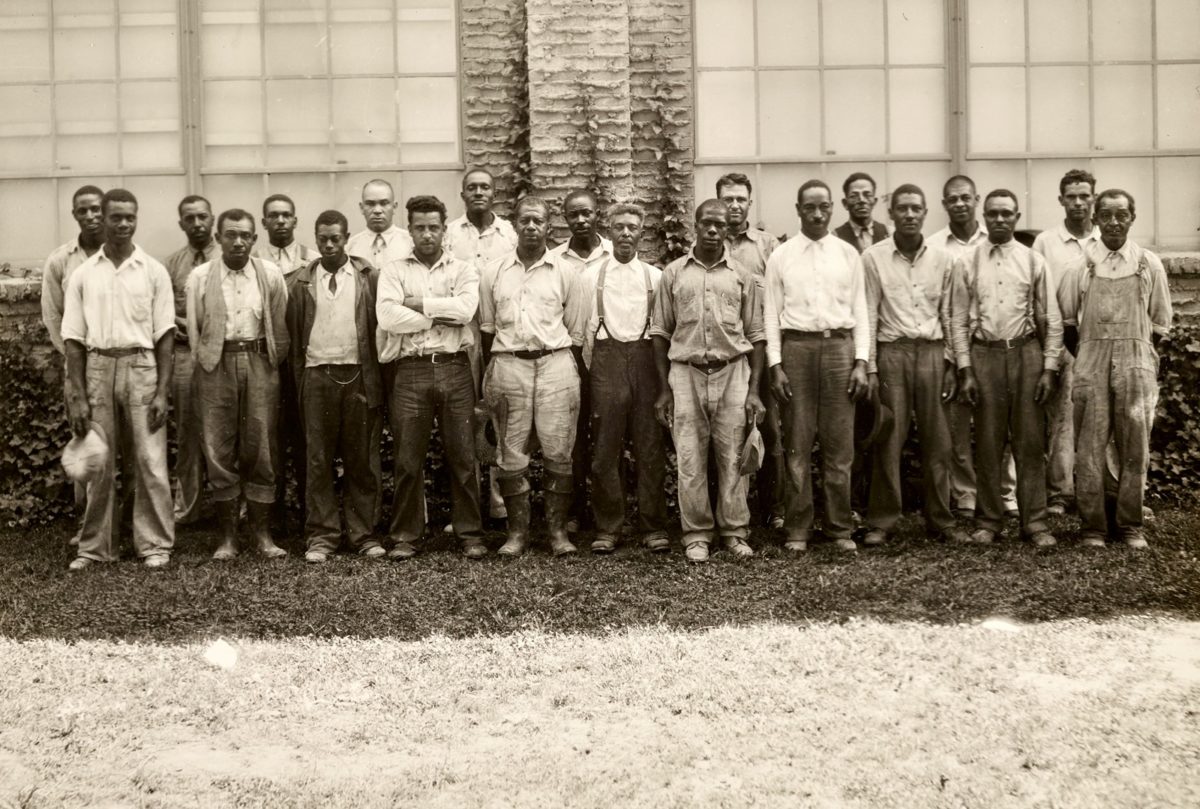
“Photographs of the Personnel of The Mariners’ Museum” dated 1935. INST-ST-28, Courtesy of The Mariners’ Museum and Park.

Whatis“Hidden Histories”?

Just as I was about ready to post this blog, I had to rewrite my opening because I just spent 45 rewarding minutes on the phone with a wonderful gentleman, Mr. Brown. Our mission at The Mariners’ Museum and Park is to connect people to the world’s waters – because through the waters, through our shared maritime heritage – we are connected to one another.Read more

Be My Mariner? Share a Secret with Your Mariner Valentine

Posted on

This year we are going to explore the making and use of, drumroll please, Invisible Ink to send secrets to your Valentine!

This year we are going to explore the making and use of, drumroll please, Invisible Ink to send secrets to your Valentine!

Hampton Roads during WWII: Army Nurse Corps

Posted on
Major Walter C. Stebbins stands with the 81st Field Hospital Unit during debarkation. To his right is Captain Eileen E. Donnelly Chief Nurse of the 81st Field Hospital Unit since its activation.

The United States Army Nurse Corps (ANC) was formally established by the US Congress in 1901. Women served as nurses in previous wars, but it wasn’t until 1901 that they were officially on Army Payroll. The ANC did not see large numbers of active duty nurses until World War I, when 20,000 registered Nurses joined. Numbers dropped after the end of WWI, and in 1941 there were fewer than 1,000 Nurses in the ANC. After the bombing of Pearl Harbor numbers quickly grew; six months later there were over 12,000 on duty Nurses. Over the course of World War II, over 59,000 nurses served in the ANC,many serving abroad in North Africa, England, Burma and the Southwest Pacific.

While many of the enrollees had nursing experience, few had military experience. A four week training course was instituted for ANC Nurses which taughtArmy organization; military customs and courtesies; field sanitation; defense against air, chemical, and mechanized attack; personnel administration; military requisitions and correspondence, and property responsibility.Nurses worked in all areas of the army-they went wherever the wounded were, and during WWII they worked close to the front lines.Nurses served under fire in field hospitals and evacuation hospitals, on hospital trains and hospital ships, and as flight nurses on medical transport planes.Read more

Brittle Fracture: When Ships Split in Two

Posted on
Daniel J. Morrell
Great Lakes steamshipDaniel J. Morrell. Photograph by Pesha Art Company, of Marine City, Michigan.

Last month, I began writing about the case of theDaniel J. Morrell, a Great Lakes bulk carrier built in 1906 that went down in a gale in November of 1966. I thought I would tell the story of how the ship split in two, and how all hands perished save 1 man. I thought, “How very like the story of that film,The Finest Hours, that told the story of Bernie Webber and his crew of Coasties who saved 32 sailors from the wreck of the T2 tankerPendleton.In both cases, the bow section split off and sank, as the stern section just sailed on.” The Michael Tougias & Casey Sherman book of the same name, by the way, served as the basis for the movie.

Then I thought about other ships that split. The T2 tankerFort Mercer, that went down in the same storm asPendleton. TheCarl D. Bradley,another Laker. The T2 tankerSchenectady, just sitting at dock when it suddenly hogged and split. Historians have documented 19 Liberty ships as having split in 2 without warning. There were just too many ships, too many lives lost! What was happening to these vessels?Read more