












|
 |

World War II
During World War II, women took on more active roles at the shipyard. The joiner shop employed a crew of women; there were twenty-one female crane operators; and the steel shop and electrical departments placed women in technical positions.
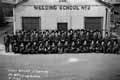 |
First Class of Women Welders Trained at the Yard
1945
From theShipyard Bulletin,
March/April 1945
Newport News Shipbuilding and Dry Dock Company
|
During World War II, twenty women began training at Welding School No. 2. Within the next week, a total of fifty women were being trained in tack-welding. Upon completing the course, they were assigned to the Fitters Department, where some continued with full welding training. Because work on the ships was considered too strenuous for women, they were assigned to the shops and the skids, where the ship's components were laid out and assembled prior to installation. Some of the women welders were thought to have a good aptitude because they were able to hold their hands steadier than the average man.
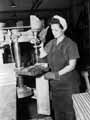 |
Mary Clanton Operating a Drill Press
1945
From theShipyard Bulletin,
May 1945
Newport News Shipbuilding and Dry Dock Company
|
 |
5th War Loan, "Our Quota is . . . ,"
1944
The Mariners' Museum
|
Mary Clanton was one of the first women employed in the Joiners Department at Newport News Shipbuilding. Training for this department took thirty days, and included blueprint reading, material identification, tool use, and operation of machines such as the drill press, steel-cutting band saw, wood plane, and boring machines. After training, the women would take on the duties of mechanic's helper.
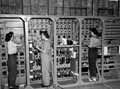 |
Electricians Installing Instrument Wiring on a Switchboard
1945
From theShipyard Bulletin,
June 1945
Newport News Shipbuilding and Dry Dock Company
|
Wyona Smith, Virginia Smith, and Marion Pucket were among 298 women who trained in the Electricians Department from 1941 to 1945. During this time, 10,162 men were also trained. To hone their skills under actual working conditions, trainees were taught using the simulated structures of a ship.
In addition to working, women were expected to continue their patriotic duty by buying bonds. This poster shows not only a man, but also a working woman promoting bond purchasing.
Activity:
Ask around the community and interview a man or woman who worked in a wartime factory.
What was his or her job? If this is a woman, why did she decide to go to work? What did she do after the war was over? |
|
Section 2 of 2 |Next Page >>
|
|


