












|
 |

Faces That Launched Thousands
of Ships: Female Figureheads
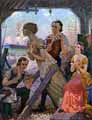 |
Carving the Figurehead,
1937 Oil on canvas by James Calvert Smith
The Mariners' Museum
|
Images of women have always played an important role in sailors' superstitions. The Phoenicians, Egyptians, Romans, and others carved and painted feminine symbols on their vessels to protect them at sea.
The practice of figurehead carving reached its height during the nineteenth century. Images of Greek and Roman goddesses and other women became popular subjects for shipcarvers. Toward the end of the century, it became common practice for a shipowner to
|
|
Sc的傀儡hoonerIrma Bentley,
1908 Carved by Alfred Nichols
The Mariners' Museum |
commission a figurehead with the likeness of his wife or daughter, and to name the vessel in her honor.
This figurehead is from a schooner built in1908 for George Edward Bentley. Bentley named the vessel after his daughter Irma "because she didn't get seasick, and climbed the ratlines with ease."
A letter written by a family member in 1963 stated that on one of the vessel's trips, a prolonged calm was blamed on a woman (the figurehead) being aboard the ship. The carving was taken off and later purchased by The Mariners' Museum as an unidentified figurehead. During a chance visit, Irma Bentley's older sister recognized her sister's image; Irma herself later made several visits to the Museum and her figurehead.
 |
Irma may be the little girl standing with the dog in this photograph. Her mother is the second from left in the second row; her father, George Bentley, is second from the right in the front row.
|
George Bentley Family and Crew Aboard Unidentified Vessel
The Mariners' Museum Research Library and Archives,
Gift of Mrs. R. W. Carter |
Section 3 of 4 |Next Page >>
|
|


