
Mariner的Astrolabe.
工具
Ancient
要闻速览:
Astrolabe是所有高度测量装置中最古老的一个,是一个角度测量工具。它的名字来自希腊语,“乘坐明星”。

介绍
Mariner的Astrolabe是一种用于占领太阳或明星海拔的导航工具。它的历史可以追溯到古代时期并进入中世纪。它的名字意味着“乘坐明星”或“明星接受者”。Mariner的Astrolabe是200多年来的首选文书。哥伦布和麦哲伦等水手在海洋旅行期间依靠这个工具。1
历史
The mariner’s astrolabe was an important navigational tool for finding latitude. It is a simplified version of the traditional astrolabe – an instrument that could help tell time, find altitude, and find latitude. The mariner’s astrolabe measures the height of the sun or a star above the horizon. Used with star and planetary charts and tables, the observer can find their latitude. Astrolabe history begins in ancient Greece. Many scholars credit Hipparchus, an ancient Greek astronomer and mathematician, with the invention of the astrolabe.2Astrolabes描述和建造的第一个主要作者是古代天文学家Claudius Ptolemy。他对他在叫做Planisphaerium的着作中最早的用途提供了很多细节。在最早的使用中,Astrolabe用于天文学 - 对星星的研究 - 以及讲述时间,但不一定用于导航。虽然古希腊天文学家开发了一个版本的Astrolabe,但在9世纪,伊斯兰世界高度发达的Isntrument。3.Astrolabe在伊斯兰宗教中非常有价值。它有助于确定天文定义的祈祷时间,并援助找到麦加 - 伊斯兰教的最神圣城市的方向。
The astrolabe was introduced to Europe from Islamic Spain (al-Andalus) in the early 12th century. Early Islamic astrolabes were typically used for land journeys. As Europeans began traveling farther distances across oceans, the created a version of the astrolabe for sea travel. Thus, the mariners’ astrolabe was born.It became widely used in Europe in the late Middle Ages and Renaissance, peaking in popularity in the 15th and 16th centuries. A knowledge of astronomy was considered to be fundamental in education. We know today that almost one-third of all known astrolabes were made in Portugal during the 16th and 17th centuries.4.几个世纪以来,阿斯特罗比被认为是基本的天文教育工具之一。早期的仪器由黄铜或木材制成。水手的Astrolabes通常是由黄铜或铁制成的。这使它们变得沉重但坚固。更好地用于移动容器,这允许更准确地测量纬度。它们的尺寸范围:大小为4英寸,直径为24英寸。在早期导航时期,水手无法确定经度,但确实知道如何找到纬度。通过了解这一点,导航员可以找到纬度线和沿着它的东方或西部驶向目的地。Mariner的Astrolabe对这项任务非常有用。尽管是一个有用的工具,但是Mariner的Astrolabe有问题。 It was not always an accurate tool at sea because it is difficult to keep it steady on a rolling ship and in high winds. This could result in degree errors that may throw a ship off course. The mariner’s astrolabe remained the most popular astronomical instrument until the end of the seventeenth century. It became replaced by more accurate instruments such as quadrants and sextants.5.
这个怎么运作
水手的星盘措施之间的角度a star and the horizon. Generally, sailors would measure the angle using the sun during the day, and Polaris (the north star) at night. There are several key parts to the mariner’s astrolabe. The ring at the top is what the navigator would hold to suspend or dangle the astrolabe. The alidade contained two small holes which the user would use to sight the sun or star. And the wheel which displayed a degree scale. So how does it work?
白天的测量将使用中午太阳进行。为了正确测量角度,Astrolabe必须垂下,以便它垂直(⊥)到海洋。接下来,导航器使用剩余的浪点来向两个孔排列,使太阳的光线通过两个孔。然后,导航器从Astrolabe的圆周周围读取角度测量。alidade将在学位规模上表明太阳的高度。该角度将与星图和表格进行比较,海拔高度可用于确定纬度。6.Measurements at night were used differently. Stars were observed by holding the instrument up to the eye. The user would line the pinholes of the alidade so that they could see the star through both holes. The alidade would indicate the altitude on the degree scale. This angle would be compared to star charts and tables, the altitude could be used to determine latitude.7.
Endnotes
- Peter Ifland,乘坐星星:来自Argonauts到宇航员的天体导航(马拉巴尔:Krieger Publishing Company,1998),7。
- Timothy M. Kusky and Katherine E. Cullen,地球和空间科学百科全书(纽约:文件,Inc.,2010),375 - 376。
- Gerard L’E Turner,科学仪器1500 - 1900:介绍(伦敦:菲利普威尔逊出版社,1998年),13。
- Peter Ifland,Taking the Stars,6。
- Helaine Selin,Ed。,Encyclopaedia of the History of Science, Technology, and Medicine in Non-Western Cultures(Dordrecht, The Netherlands: Kluwer Academic Publishers, 1997), 75.
- Robert Bud和Deborah Jean Warner,Eds。,科学文书:历史百科全书(London: Taylor & Francis Group, 1998), 36.
- Robert Bud和Deborah Jean Warner,Eds。,科学仪器,36。
Bibliography
Bud, Robert and Deborah Jean Warner, eds.科学文书:历史百科全书。London: Taylor & Francis Group, 1998.
Ifland,彼得。乘坐星星:来自Argonauts到宇航员的天体导航。Malabar: Krieger Publishing Company, 1998.
Kusky,Timothy M.和Katherine E. Cullen。地球和空间科学百科全书。纽约:2010年文件的事实,Inc。。
L'E Turner,Gerard。科学仪器1500 - 1900:介绍。伦敦:菲利普威尔逊出版商,1998年。
Selin,Helaine, ed.Encyclopaedia of the History of Science, Technology, and Medicine in Non-Western Cultures。DONDRECHT,荷兰:KLLWER学术出版商,1997年。
画廊
-
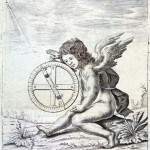
- Astrolabe是一系列新的航行,发现和旅行:在欧洲,亚洲,非洲和美国,1767年,从库尔博物馆的图书馆举行,含有任何值得通知的东西,G160.k75罕见。

-
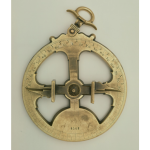
- Mariner的Astrolabe.from the collection of The Mariners’ Museum and Park (catalog #: 1963.0003.000001)

-
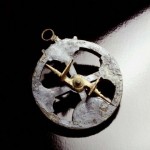
- Mariner的Astrolabe., Portuguese, 1645, by Nicholao Ruffo, The Mariners’ Museum, (2000.52.1)
-
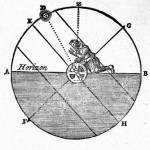
- 使用Astrolabe,Le Noveau Phalot de La Mer,1635,来自库里的库博物馆,VK801.J35.1635罕见。

-
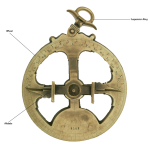
- Labled parts of the mariner’s astrolabe


